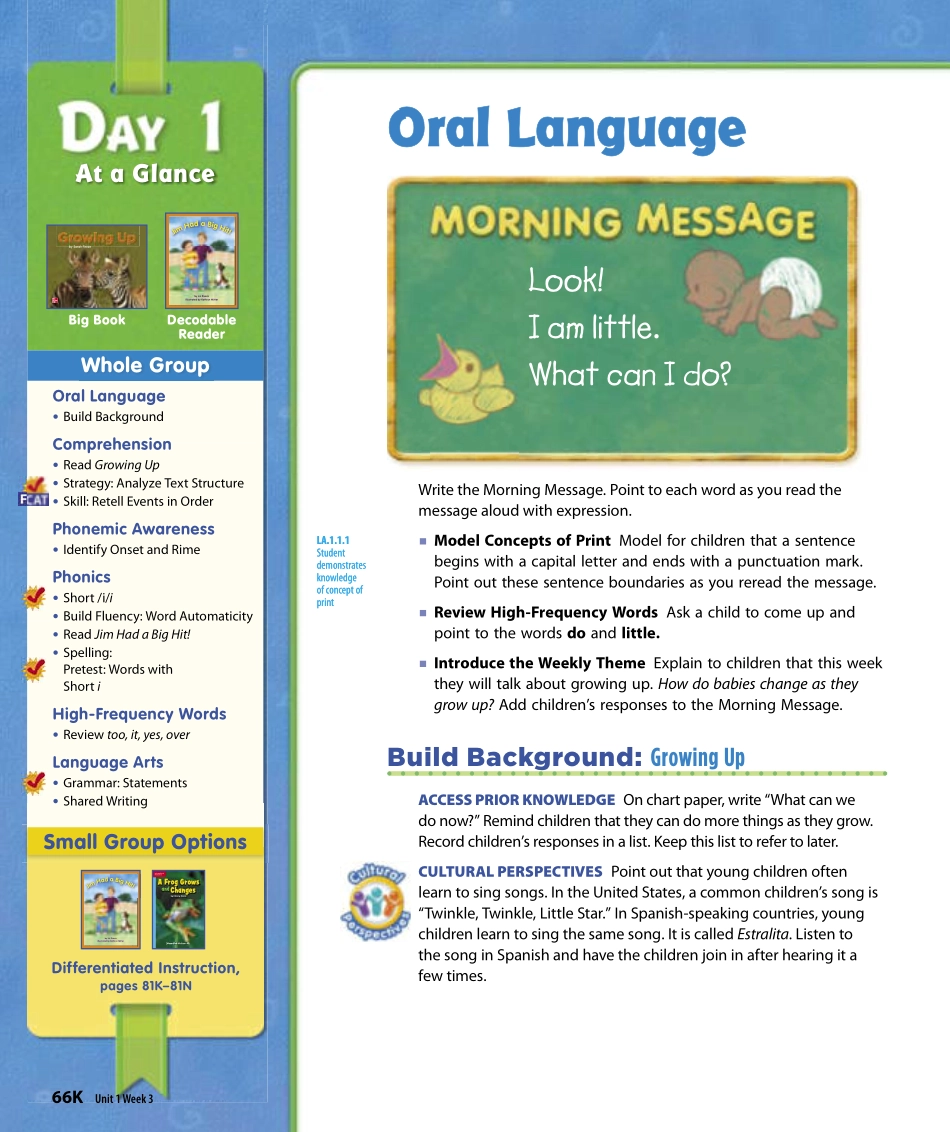
AtaGlanceWholeGroupSmallGroupOptionsOralLanguage•BuildBackgroundComprehension•ReadGrowingUp•Strategy:AnalyzeTextStructure•Skill:RetellEventsinOrderPhonemicAwareness•IdentifyOnsetandRimePhonics•Short/i/i•BuildFluency:WordAutomaticity•ReadJimHadaBigHit!•Spelling:Pretest:WordswithShortiHigh-FrequencyWords•Reviewtoo,it,yes,overLanguageArts•Grammar:Statements•SharedWritingDifferentiatedInstruction,pages81K–81NOralLanguageOralLanguageWritetheMorningMessage.Pointtoeachwordasyoureadthemessagealoudwithexpression.■ModelConceptsofPrintModelforchildrenthatasentencebeginswithacapitalletterandendswithapunctuationmark.Pointoutthesesentenceboundariesasyourereadthemessage.■ReviewHigh-FrequencyWordsAskachildtocomeupandpointtothewordsdoandlittle.■IntroducetheWeeklyThemeExplaintochildrenthatthisweektheywilltalkaboutgrowingup.Howdobabieschangeastheygrowup?Addchildren’sresponsestotheMorningMessage.BuildBackground:GrowingUpACCESSPRIORKNOWLEDGEOnchartpaper,write“Whatcanwedonow?”Remindchildrenthattheycandomorethingsastheygrow.Recordchildren’sresponsesinalist.Keepthislisttorefertolater.CULTURALPERSPECTIVESPointoutthatyoungchildrenoftenlearntosingsongs.IntheUnitedStates,acommonchildren’ssongis“Twinkle,Twinkle,LittleStar.”InSpanish-speakingcountries,youngchildrenlearntosingthesamesong.ItiscalledEstralita.ListentothesonginSpanishandhavethechildrenjoininafterhearingitafewtimes.LA.1.1.1StudentdemonstratesknowledgeofconceptofprintLA.1.1.1StudentdemonstratesknowledgeofconceptofprintJimHadaBigHit!byLizRiveraillustratedbyKathrynMitter6952_RD1_U01_W03_13-18.indd133/18/058:37:59AMBigBookDecodableReader[setfacsimileforDecodableReaderJimHasaBigHit!]JimHadaBigHit!byLizRiveraillustratedbyKathrynMitter6952_RD1_U01_W03_13-18.indd133/18/058:37:59AMInformationalNonfictionAFrogGrowsandChangesbyChristySteeleMacmillan/McGraw-HillbySarahFinton6/20/059:56:46PMLook!Iamlittle.WhatcanIdo?66KUnit1Week3TALKANDWRITEABOUTTHEPICTUREPROMPTDiscusstheFocusQuestionHowhaveyouchangedsinceyouwerelittle?D...