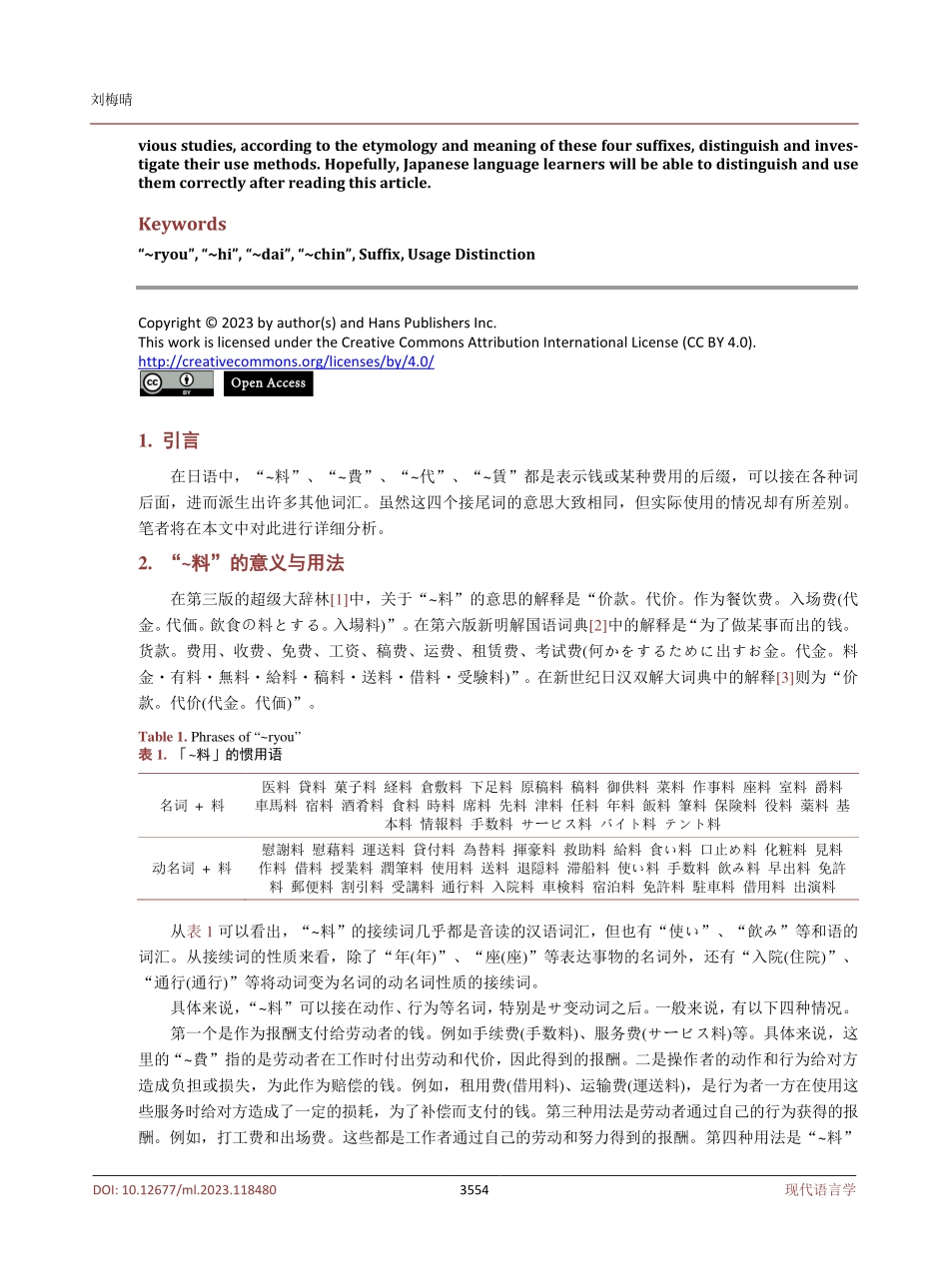
ModernLinguistics现代语言学,2023,11(8),3553-3557PublishedOnlineAugust2023inHans.https://www.hanspub.org/journal/mlhttps://doi.org/10.12677/ml.2023.118480文章引用:刘梅晴.“~料”、“~費”、“~代”、“~賃”接尾词的用法区分[J].现代语言学,2023,11(8):3553-3557.DOI:10.12677/ml.2023.118480“~料”、“~費”、“~代”、“~賃”接尾词的用法区分刘梅晴南京理工大学外国语学院,江苏南京收稿日期:2023年7月11日;录用日期:2023年8月8日;发布日期:2023年8月21日摘要日语中有“~料”、“~費”、“~代”、“~賃”这四个近义接尾词。这四个后缀的基本意思都是“钱”。但是,在使用的时候,往往存在一定的区别。经过笔者的初步调查发现,先前的研究者关于这个课题的研究存在断层,并且研究的数量也不多。因此,笔者在本文中,将在前人研究的基础上,根据这四个后缀的语源和意义,对它们的使用方法进行区分和考察。希望日语学习者在看完本文后,能够正确地区分和使用它们。关键词“~料”,“~費”,“~代”,“~賃”,接尾词,用法区分TheUsageDistinctionofSuffixof“~ryou”,“~hi”,“~dai”,“~chin”MeiqingLiuSchoolofForeignStudies,NanjingUniversityofScienceandTechnology,NanjingJiangsuReceived:Jul.11th,2023;accepted:Aug.8th,2023;published:Aug.21st,2023AbstractInJapanese,therearefournear-senseendings:“~ryou”,“~hi”,“~dai”and“~chin”.Allfoursuffixesbasicallymean“money”.However,whenused,thereisoftenacertaindifference.Aftertheauthor’spreliminaryinvestigation,itisfoundthattherearefaultsinthepreviousresearchonthissubject,andthenumberofstudiesisnotlarge.Therefore,inthispaper,theauthorwill,onthebasisofpre-刘梅晴DOI:10.12677/ml.2023.1184803554现代语言学viousstudies,accordingtotheetymologyandmeaningofthesefoursuffixes,distinguishandinves-tigatetheirusemethods.Hopefully,Japaneselanguagelearnerswillbeabletodistinguishandusethemcorrectlyafterreadingthisarticle.Keywords“~ryou”,“~hi”,“~dai”,“~chin”,Suffix,UsageDistinctionCopyright©2023byauthor(s)andHansPublishersInc.ThisworkislicensedundertheCreativeCommonsAttributionInternationalLicense(CCBY4.0).http://creativecommons.org/licenses/by/4.0/1.引言在日语中,“~料”、“~費”、“~代”...