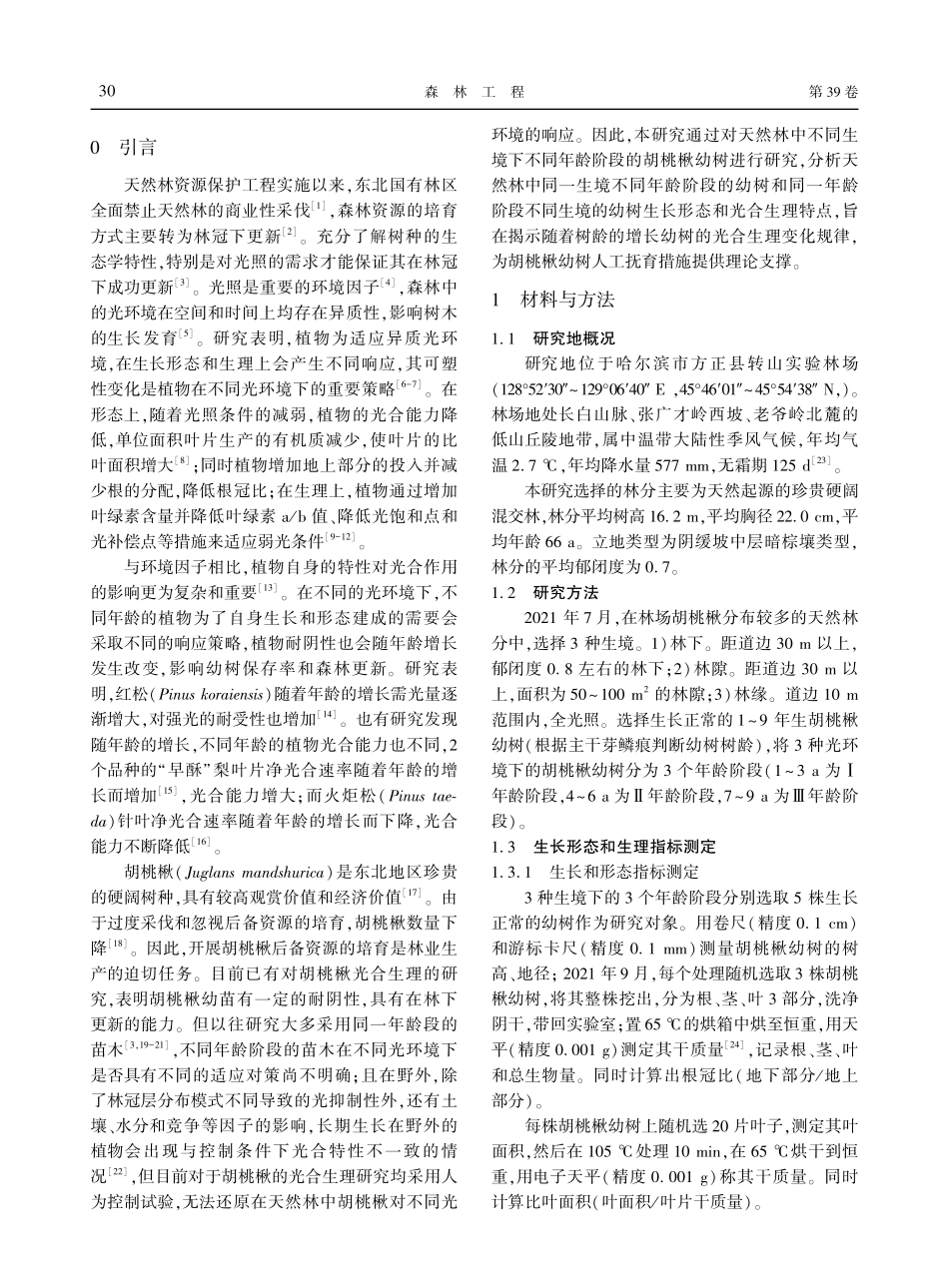
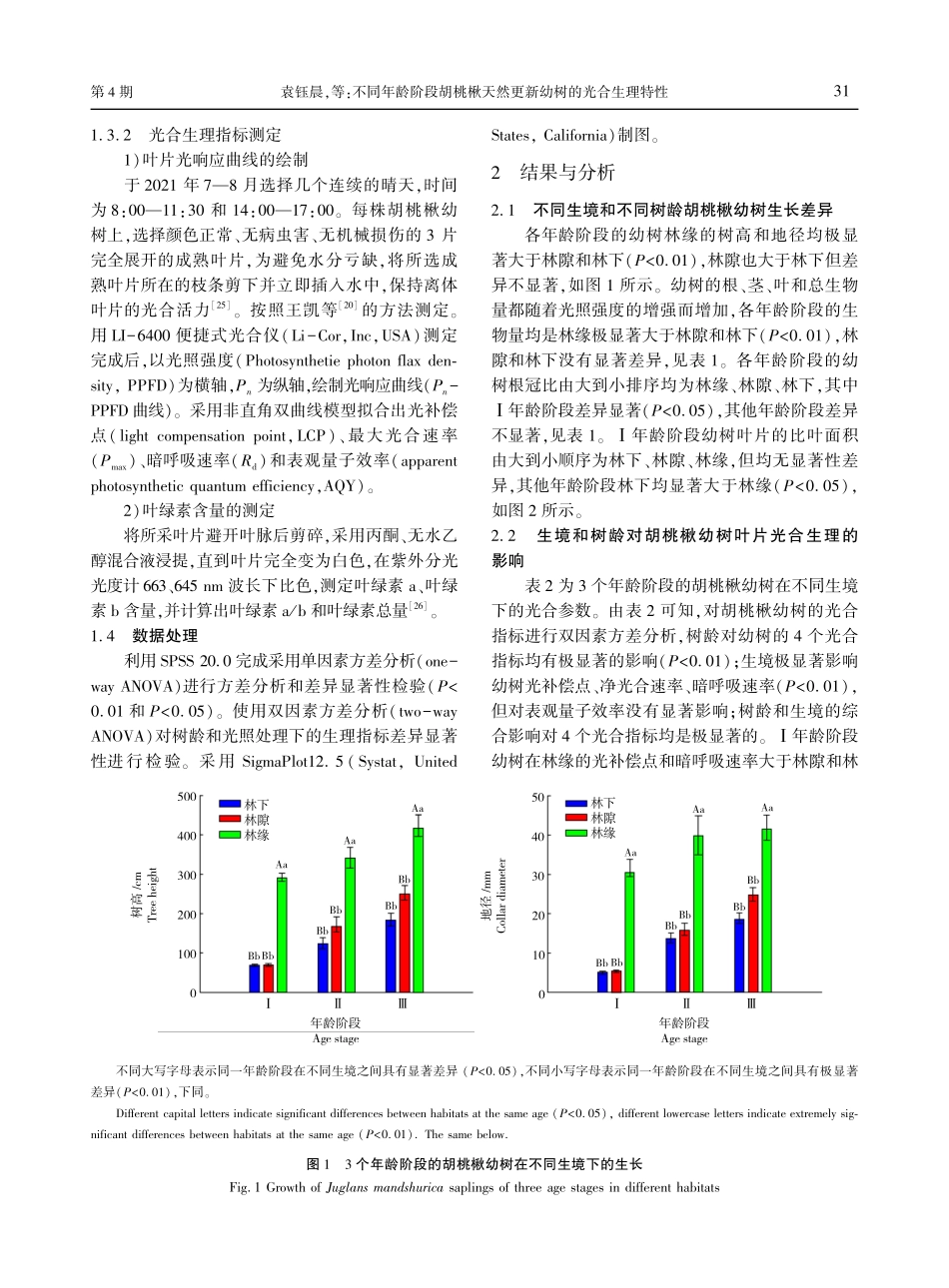
第39卷第4期2023年7月森林工程FORESTENGINEERINGVol.39No.4Jul.,2023doi:10.3969/j.issn.1006-8023.2023.04.004不同年龄阶段胡桃楸天然更新幼树的光合生理特性袁钰晨,谢旭强,徐立清,于均屹,蔡智,王庆成∗(东北林业大学林学院,哈尔滨150040)摘要:探究不同树龄胡桃楸(Juglansmandshurica)幼树适宜的光环境条件,为制定林下胡桃楸幼树的人工抚育措施提供理论依据。以哈尔滨市方正县转山实验林场的树龄为1~3a(Ⅰ年龄阶段)、4~6a(Ⅱ年龄阶段)和7~9a(Ⅲ年龄阶段)的胡桃楸天然更新幼树为研究对象,测定其在不同光环境(林缘、林隙和林下)的生长形态和光合指标。结果表明,随着光照强度的减弱,各年龄阶段的幼树生物量、苗高和地径降低,比叶面积增大;叶片叶绿素a/b值、光补偿点(LightCompensationPoint,LCP)、最大净光合速率(maximumnetphotosyntheticrate,Pmax)、暗呼吸速率(Darkrespirationrate,Rd)下降,叶绿素含量升高。在林下和林隙中,Ⅱ年龄阶段的幼树叶片最大净光合速率和叶绿素含量最高,叶片光补偿点、暗呼吸速率和叶绿素a/b最低;在林缘,随着树木年龄的增长叶片最大净光合速率和光补偿点逐渐增大。综上所述,林缘更适宜幼树的生长。此外,对4~6a的胡桃楸幼树进行抚育时,可适当降低抚育强度;而对1~3a和7~9a的胡桃楸幼树进行人工抚育时,要加强抚育力度,及时对上层林木透光。关键词:胡桃楸;幼树;树龄;生境;天然更新;光合生理中图分类号:S754.5文献标识码:A文章编号:1006-8023(2023)04-0029-09PhotosyntheticPhysiologicalCharacteristicsofNaturallyRegeneratedJuglansmandshuricaSaplingsatDifferentAgesYUANYuchen,XIEXuqiang,XULiqing,YUJunyi,CAIZhi,WANGQingcheng∗(SchoolofForestry,NortheastForestryUniversity,Harbin150040,China)Abstract:ThisstudywasaimedtoinvestigatetheappropriatelightconditionsforJuglansmandshuricasaplingsofdifferentages,andprovideatheoreticalbasisforthedevelopmentofartificialtendingmeasuresforJ.mandshuricasaplingsintheunderstory.Inthisstudy,naturalregenerationofJ.mandshuricasaplingsaged1-3a(agestageⅠ),4-6a(agestageⅡ)and7-9a(agestageⅢ)intheexperimentalforestryfarmofZhuanShan,FangzhengCounty,HarbinCitywereusedasexperimentalsubjects,determiningtheirgrowthpatternsandphotosyntheticindicatorsindifferentlightenvironments(forestedge,forestgapandunderstory).Theresultsshowedthat:as...