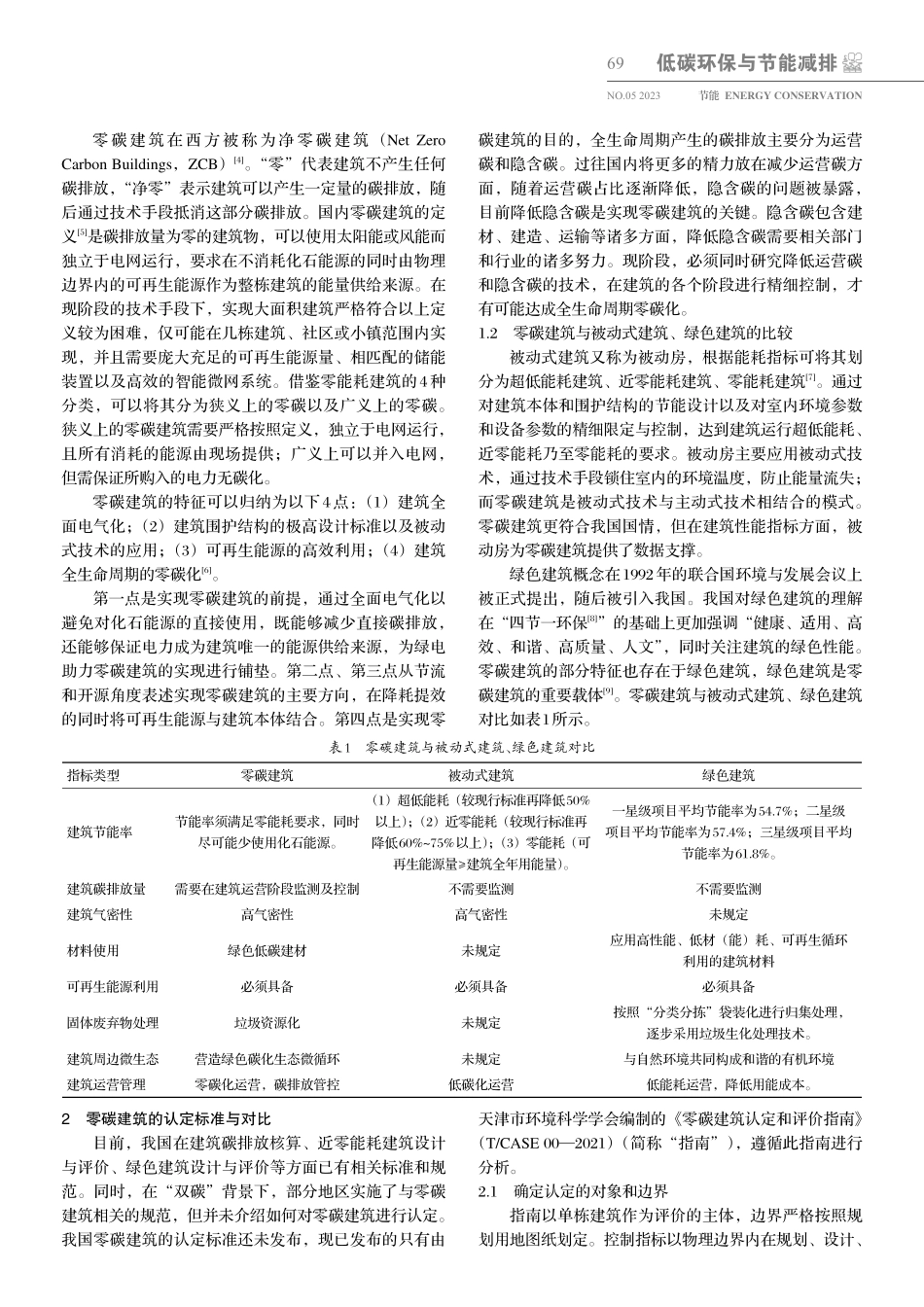
低碳环保与节能减排68节能ENERGYCONSERVATIONNO.052023零碳建筑及其关键技术分析冯国会吴苏洋*常莎莎(沈阳建筑大学市政与环境工程学院,辽宁沈阳110168)摘要:全面建成零碳建筑是我国实现“双碳”目标路径上非常重要的一步。详细介绍零碳建筑的内涵与特征,并与被动式建筑、绿色建筑进行对比,厘清三者间的内在联系;阐述国内如何对零碳建筑进行认定并与国外的认定规则进行对比,为规则的完善指明方向;从运营碳、隐含碳和控制技术角度对零碳建筑的关键技术进行分析,指出需要大力发展和改进的方向。关键词:零碳建筑;碳排放核算;碳中和;运营碳;隐含碳中图分类号:TU201.5文献标识码:B文章编号:1004-7948(2023)05-0068-05doi:10.3969/j.issn.1004-7948.2023.05.018Analysisofzero-carbonbuildingsandit'skeytechnologiesFENGGuo-huiWUSu-yangCHANGSha-shaAbstract:Thecomprehensivecompletionofzero-carbonbuildingsisaveryimportantstepinChinatoachievethe'doublecarbon'goal.Thepaperintroducestheconnotationandcharacteristicsofzero-carbonbuildingsindetail,comparesthemwithpassivebuildingsandgreenbuildings,clarifiestheinternalrelationshipbetweenthethree.Itexpoundshowtoidentifyzero-carbonbuildingsinChinaandcomparethemwithforeignidentificationrules,andpointoutthedirectionfortheimprovementoftherules.Thekeytechnologiesofzero-carbonbuildingsareanalyzedfromtheperspectiveofoperatingcarbon,hiddencarbonandcontroltechnology,andthedirectionofvigorousdevelopmentandimprovementispointedout.Keywords:zero-carbonbuilding;carbonemissionsaccounting;carbonneutralization;operatingcarbon;hiddencarbon引言与19世纪末期相比,21世纪初期全球平均地表温度上升0.87℃[1]。截至2020年,全球平均地表温差升至1.2℃。若不改变高碳排放以及高能耗的生产生活模式,将导致全球气温继续上升,突破1.5℃的温差限值对全球的影响和破坏不可估量。我国一直致力于人类命运共同体的构建以及推动人类社会可持续健康发展,对全球变暖问题给予充分重视。据我国建筑节能协会《中国建筑能耗研究报告(2020)》[2]显示,2018年全国建筑全过程能耗总量为21.47亿吨标准煤,占全国能源消费总量的46.5%。建筑业碳排放量占据较大份额,实现建筑业的降碳是专家学者均在思索的问题,零碳建筑的概念应运而生。但是国内目前对零碳建筑...