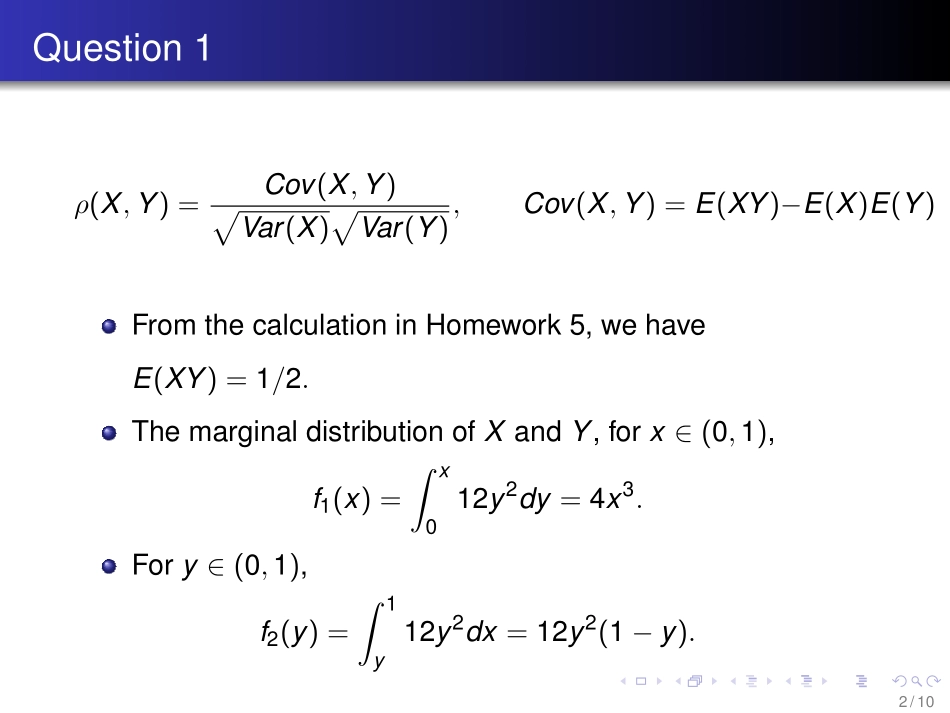
Solutions6GuanghuaSchoolofManagementPekingUniversityNovember9,20121/10Question1ρ(X,Y)=Cov(X,Y)�Var(X)�Var(Y),Cov(X,Y)=E(XY)−E(X)E(Y)FromthecalculationinHomework5,wehaveE(XY)=1/2.ThemarginaldistributionofXandY,forx∈(0,1),f1(x)=�x012y2dy=4x3.Fory∈(0,1),f2(y)=�1y12y2dx=12y2(1−y).2/10Question1continuedCalculateE(X),Var(X),E(Y),Var(Y),E(X)=�10xf1(x)dx=�104x4dx=45E(X2)=�10x2f1(x)dx=�104x5dx=23.Var(X)=E(X2)−E(X)2=275.E(Y)=�10yf2(y)dy=�1012y3(1−y)=35.E(Y2)=�10y2f2(y)dy=�1012y4(1−y)=25.Var(Y)=E(Y2)−{E(Y)}2=125(1)Calculteρ(X,Y).3/10Question2Usetheformula:Var(X+Y+Z)=Var(X)+Var(Y)+Var(Z)+2Cov(X,Y)+2Cov(X,Z)+2Cov(Y,Z)Var(3X−Y−2Z+1)=Var(3X−Y−2Z)=9Var(X)+Var(Y)+4Var(Z)−6Cov(X,Y)−12Cov(X,Z)+4Cov(Y,Z).4/10Question3.Wehaveµ=6.5,E(¯Xn)=µ=6.5,Var(¯Xn)=4/n.FromtheChebyshevinequalityP(6≤¯Xn≤7)=P(−0.5≤¯Xn−6.5≤0.5)=P(|¯Xn−6.5|≤0.5)>1−Var(¯Xn)0.52=1−16n.1−16n=0.8,thenn=80.5/10Question4.Proof:E(Zn)=n2P(Zn=n2)+0P(Zn=0)=n→∞.Foranyϵ>0,P(|Zn|>ϵ)=P(Zn=n2)=1n→0.ThenZnp→0.6/10Question5.SupposeX∼N(µ,σ2),thenP(X1−σ2/nσ2/16=1−16n.Let1−16n=0.99,thenn=1600.8/10Question6.Method2:Usethefact¯XnisalsoanormaldistributionN(µ,σ2/n),thenwehave√n(¯Xn−µ)σ∼N(0,1).P(√n|(¯Xn−µ)|σ≤√n4)=Φ(√n4)−Φ(−√n4)=2Φ(√n4)−1.WhereΦ(·)isthecumulativedistributionfunctionofstandardnormaldistribution.Then2Φ(√n4)=1.999/10Question6.FromthefactΦ(2.575829)=0.995,wehaven=106.15.Letn=107,thesamplesizeismuchsmallerbecausewehavemoreinformationaboutthedistribution.10/10