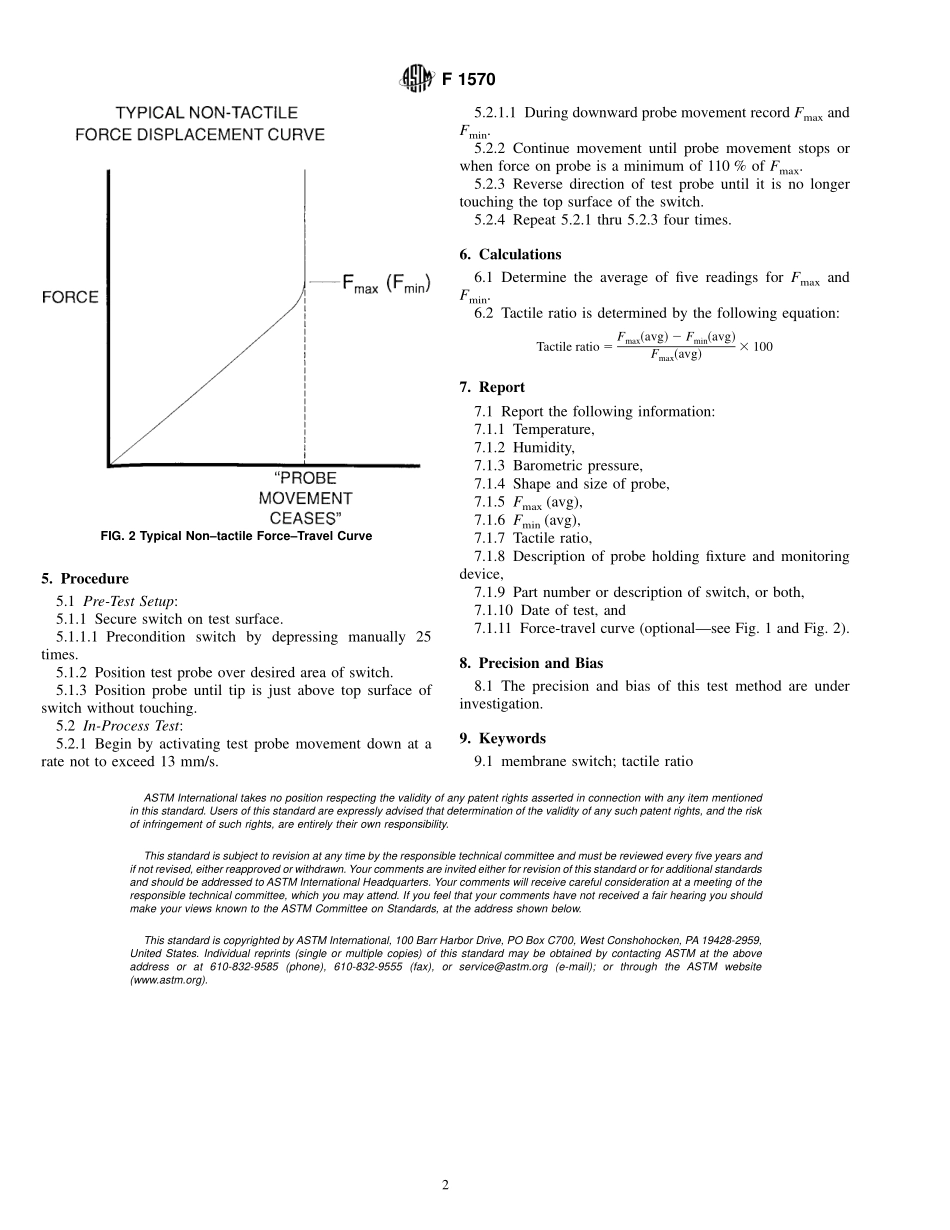
Designation:F1570–01e1StandardTestMethodforDeterminingtheTactileRatioofaMembraneSwitch1ThisstandardisissuedunderthefixeddesignationF1570;thenumberimmediatelyfollowingthedesignationindicatestheyearoforiginaladoptionor,inthecaseofrevision,theyearoflastrevision.Anumberinparenthesesindicatestheyearoflastreapproval.Asuperscriptepsilon(e)indicatesaneditorialchangesincethelastrevisionorreapproval.e1NOTE—Theequationin6.2wascorrectededitoriallyinDecember2001.1.Scope1.1Thistestmethodcoversthedeterminationofthetactileresponseofamembraneswitchasdefinedbytactileratio.1.2Thisstandarddoesnotpurporttoaddressallofthesafetyconcerns,ifany,associatedwithitsuse.Itistheresponsibilityoftheuserofthisstandardtoestablishappro-priatesafetyandhealthpracticesanddeterminetheapplica-bilityofregulatorylimitationspriortouse.2.Terminology2.1Definitions:2.1.1Fmax—maximumforcemeasuredpriortoorincludingpoint(Fmin)(seeFig.1andFig.2).2.1.2Fmin—minimumforceseenbetweenFmaxandpointatwhichprobemovementceases.2.1.2.1Discussion—FmaxcanequalFmin.2.1.3force-travelcurve—relationshipbetweenforceap-pliedandtravelofamembraneswitch.2.1.3.1Discussion—Usuallyexpressedasalinegraph(seeFig.1andFig.2).2.1.4membraneswitch—amomentaryswitchingdeviceinwhichatleastonecontactison,ormadeof,aflexiblesubstrate.2.1.5non-tactileswitch—aswitchassemblythathasatactileratioequaltozero.2.1.6tactileratio—ameasureoftactileresponse(seeEq6.2).2.1.7tactileresponse—aphysicalsensation,causedbyasuddencollapseorsnapback,orboth,ofamembraneswitch.2.1.7.1Discussion—Theamountoftactileresponseisde-terminedbytheequationshownin6.2.2.1.8tactileswitch—aswitchassemblythatprovidesatactileratiogreaterthanzero.2.1.9travel—measureddistanceofmovementwhenamembraneswitchisdepressed.3.SignificanceandUse3.1Thetactileratioisusefulinquantifyingthefeelofamembraneswitch.Factorsotherthantactileratiomayaffectthe“feel”ofatactileswitch.3.2AlwaysreportthetactileratioasafunctionofmeasuredFmax.Thisisimportantbecauseitispossibletohavethesametactileratiofordif...