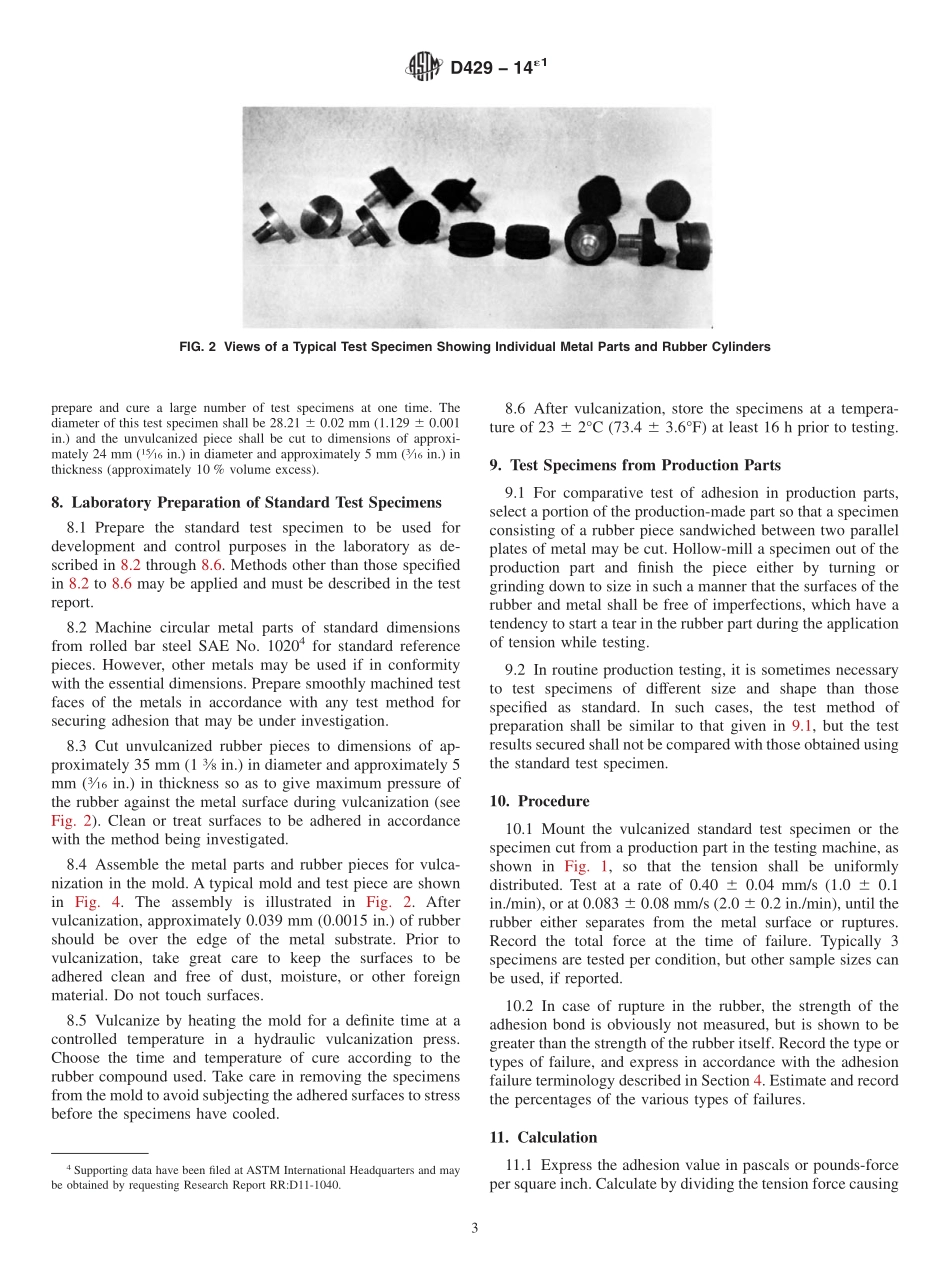
Designation:D429−14´1StandardTestMethodsforRubberProperty—AdhesiontoRigidSubstrates1ThisstandardisissuedunderthefixeddesignationD429;thenumberimmediatelyfollowingthedesignationindicatestheyearoforiginaladoptionor,inthecaseofrevision,theyearoflastrevision.Anumberinparenthesesindicatestheyearoflastreapproval.Asuperscriptepsilon(´)indicatesaneditorialchangesincethelastrevisionorreapproval.ThisstandardhasbeenapprovedforusebyagenciesoftheU.S.DepartmentofDefense.ε1NOTE—Corrected2.2editoriallyinMarch2021.1.Scope1.1Thesetestmethodscoverproceduresfortestingthestaticadhesionalstrengthofrubbertorigidmaterials(inmostcasesmetals).MethodA—RubberPartAssembledBetweenTwoParallelMetalPlates.MethodB—90°StrippingTest—RubberPartAssembledtoOneMetalPlate.MethodC—MeasuringAdhesionofRubbertoMetalwithaConicalSpecimen.MethodD—AdhesionTest—Post-Vulcanization(PV)Bond-ingofRubbertoMetal.MethodE—90°StrippingTest—RubberTankLining—AssembledtoOneMetalPlate.MethodF—RubberPartAssembledBetweenTwoParallelConvex-ShapedMetalPlatesMethodG—MeasuringBondDurabilityforRubber-to-MetalBondedComponentswithaDoubleShearCylindricalSpeci-menMethodH—MeasuringBondDurabilityforRubber-to-MetalBondedComponentswithaQuadrupleShearSpecimen1.2Whilethetestmethodmaybeusedwithawidevarietyofrigidmaterials,useofmaterialsotherthanmetalsistheexception.Forthisreason,wehaveusedtheword“metal”inthetextratherthan“rigidmaterials.”1.3ThevaluesstatedinSIunitsaretoberegardedasthestandard.Thevaluesgiveninparenthesesareforinformationonly.1.4Thisstandarddoesnotpurporttoaddressallofthesafetyconcerns,ifany,associatedwithitsuse.Itistheresponsibilityoftheuserofthisstandardtoestablishappro-priatesafety,health,andenvironmentalpracticesanddeter-minetheapplicabilityofregulatorylimitationspriortouse.1.5Thisinternationalstandardwasdevelopedinaccor-dancewithinternationallyrecognizedprinciplesonstandard-izationestablishedintheDecisiononPrinciplesfortheDevelopmentofInternationalStandards,GuidesandRecom-mendationsissuedbytheWorldTr...